Ratnyčios g. 15, Kaunas Mon–Fri 11:00–18:00

It's currently off-season, so we work by appointment only and are not on site. Call +370 615 47731

Kaunas · Ratnyčios g. 15 · urgent jobs without a queue

Bicycle brake repair in Kaunas

We adjust V-brakes and disc brakes, replace pads, cables and levers, and bleed hydraulic brakes. Brake adjustment costs 6 € excluding parts.

Adjusting the bike chain and gears during a service 6 €Brake adjustment Warranty on work
6 €
Brake adjustment
8 € excl. parts
Brake pad replacement + adjustment
13–15 €
Hydraulic brake bleeding
Kaunas
Location

2ratai.lt · Kaunas, Aukštieji Šančiai

Ratnyčios g. 15, Kaunas

Easy access and parking by the entrance

  • Mon–Fri 11:00–18:00
  • info@2ratai.lt
  • Parking right by the entrance

It's currently off-season, so we work by appointment only and are not on site.

Brakes squealing, the lever pulling too far or the bike barely stopping – that’s usually where it all starts. Often it’s enough to adjust the brakes or replace worn brake pads, but sometimes the culprit is a stretched cable, a bent rotor or air in the hydraulic system.

We repair rim brakes (V-brake), mechanical and hydraulic disc brakes, mechanical work only. Before starting, we inspect the bike and tell you what’s faulty and how much it will cost – the exact price is determined after inspecting the bike. If other components need sorting out too, see our bicycle repair in Kaunas.

  • How much does brake adjustment cost? Brake adjustment costs 6 €, brake pad replacement with adjustment – 8 €. Prices exclude parts.
  • Do I need to call before coming? From March 16 to October 14 you can drop by Mon–Fri 11:00–18:00. From October 15 to March 15 we are not on site, so you must call and arrange a time.
  • When is adjustment alone enough? When the brake pads still have material left, the rotor is straight, and the cable and fluid are in good condition. Otherwise the brake pads or cable need replacing, or the system needs bleeding.
  • Is it worth repairing a hydraulic brake? Often, yes. Bleeding costs 13–15 €, and replacing the entire hydraulic brake costs 15 € excluding parts.

What brake symptoms tell you

Brakes rarely fail suddenly – usually a noise, a spongy lever or rubbing shows up first. Below are the most common symptoms and what we usually find behind them.

016 €

Bicycle brakes squeal

WhyThe most common culprits are greasy or glazed brake pad surfaces, moisture, or a badly positioned brake pad (V-brake). With disc brakes, squealing can be caused by dirt on the rotor or pads, or by a misaligned caliper.

Check it yourselfWipe the rim or rotor with a clean cloth and don’t spray lubricant near the brakes. If it keeps squealing, see a mechanic.

What we doWe check the condition of the brake pads, clean the rotor or rim, adjust the pad position or replace them with new ones.

028 €

The bike brakes weakly

WhyMost often worn brake pads, a stretched or rusty cable, a dirty rotor, a worn rim, or air in the hydraulic system.

Check it yourselfLook at whether the brake pad still has material left. Don’t ride with weak brakes – see a mechanic.

What we doWe replace brake pads, cables and housing, adjust the system and, if needed, bleed the hydraulic brake.

0313–15 €

The hydraulic brake lever goes all the way to the handlebar

WhyMost often there is air in the system or the brake fluid is already old. Sometimes the brake pads are very worn or the fluid level has dropped because of a leak.

Check it yourselfDon’t ride with brakes that don’t work – see a mechanic.

What we doWe bleed the brakes and check the hose, fittings and brake pads. If the brake can’t be repaired, we replace it.

04

The rotor rubs against the brake pads

WhyOften the wheel or caliper has shifted, the rotor is slightly bent, or the brake pads have worn unevenly. After a wheel has been removed, the caliper may no longer line up with the rotor.

Check it yourselfSpin the wheel and see whether it rubs through the whole rotation or only at a certain spot. Check that the wheel axle is fully inserted and tightened.

What we doWe centre the caliper, check the rotor and brake pads, and replace worn parts if necessary.

0512 €

The brake lever pulls too far or works stiffly

WhyIn mechanical and V-brake brakes the cable stretches, while dirt and moisture build up in the housing. The lever then either pulls all the way to the handlebar or moves jerkily.

Check it yourselfCheck whether the cable is frayed near the lever or the brake pad mount. If you see splayed strands, the cable needs to be replaced.

What we doWe replace the cable and housing and adjust the brake travel.

066 €

V-brake pads don’t return or rub on the rim

WhyWeak springs, unbalanced adjustment screws, a warped rim or a bent arm. The pads may touch the rim even when you aren’t squeezing the lever.

Check it yourselfSee whether the wheel spins true and has no „figure-eight” wobble. If the rim is wavy, adjusting the brakes alone won’t solve the problem.

What we doWe adjust the brakes, replace the pads and, if needed, fix the wheel. Read more about this in bicycle wheel repair.

0710 €

Brake lever is broken or doesn’t return

WhyThe lever breaks after a fall, or the pivot wears out. On hydraulic brakes, a damaged lever may leak fluid.

What we doWe replace the brake levers and grips, then adjust and test the braking.

0815 €

Hydraulic brake is leaking fluid

WhyA leak usually comes from a damaged hose, fitting or caliper seals. Fluid on the pads significantly worsens their performance.

Check it yourselfIf you see fluid or oil stains on the disc or pads, don’t ride and contact a mechanic.

What we doWe find the leak, replace the brake or the affected part, bleed the system and test that it works.
Bicycle brake repair prices

Below are the prices for the most common brake jobs, excluding parts.

Adjustment and pads

ServicePriceNote
Brake adjustment6 €excluding parts
Brake pad replacement with brake adjustment8 €excluding parts
Disc (rotor) truingfrom 5 €–

Cables and levers

ServicePriceNote
Brake adjustment with cable and housing replacement12 €excluding parts
Brake lever replacement10 €excluding parts

Hydraulics

ServicePriceNote
Hydraulic brake bleeding13–15 €excluding parts
Hydraulic brake replacement15 €excluding parts
Shortening and bleeding the hydraulic hosefrom 20 €–
Prices exclude parts; parts (pads, cables, discs) are extra.

Bicycle brake myths

  • Myth. If the brakes squeal, it doesn’t matter – it’ll stop eventually. In reality. Squealing rarely goes away by itself. It often means contaminated or worn pads, or incorrect pad positioning, so it’s worth checking before the braking weakens.
  • Myth. Hydraulic brakes don’t need maintenance. In reality. Brake fluid absorbs moisture over time, and air can get into the system. So it’s worth bleeding the brakes when the lever feels spongy, and checking the pads often.
  • Myth. You should brake with only the front or only the rear brake. In reality. Braking works best when you use both brakes together. The front brake stops you the strongest, but you need to know how to modulate it when squeezing it suddenly.
  • Myth. New pad sets fit any brakes. In reality. Pads differ in shape and mounting. Before buying, check your brake model or bring the bike in so we can choose the right ones.

Bicycle brake repair by system: V-brake, mechanical and hydraulic

V-brake (rim) brakes press on the rim. They are simple and easy to adjust, but perform worse in wet or muddy weather and wear down the rim.

Mechanical disc brakes are operated by a cable, and the pads press on the disc. As the pads wear, the brakes need to be tightened from time to time. Hydraulic disc brakes are operated by fluid – they usually brake more powerfully and smoothly, but they require bleeding and cleanliness.

  • V-brake: the most common jobs are pads, cables and spring adjustment.
  • Mechanical disc: cable adjustment, pads, disc alignment.
  • Hydraulic disc: bleeding, pads, levers and full brake replacement.

If your brakes start squealing after rain, wipe the rim or disc with a clean cloth. If the squealing doesn’t go away, contact a mechanic.

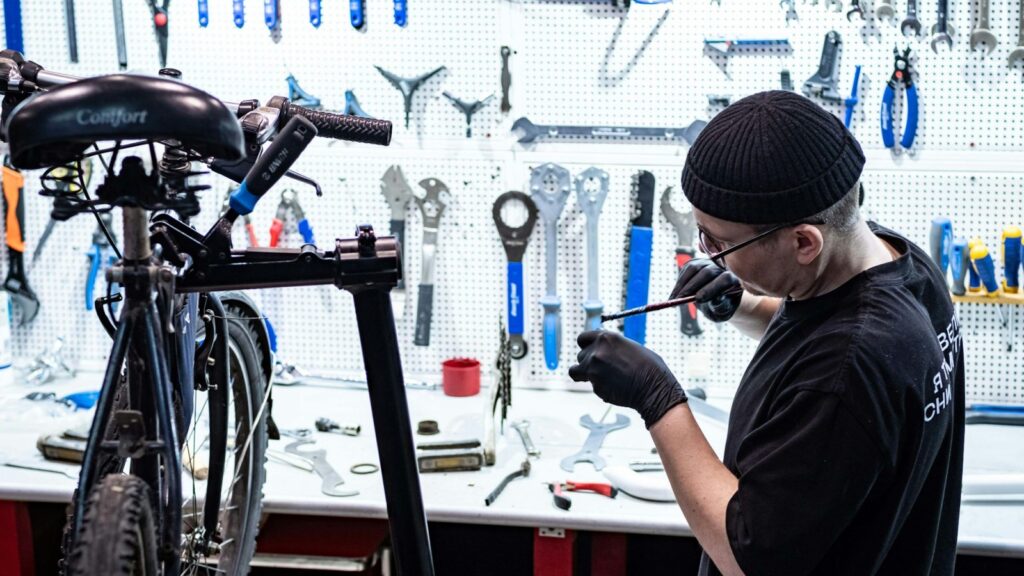
Bike repair in Kaunas: a mechanic working on a bike in the workshop

Bicycle brake repair or a new set: how to weigh the costs

It’s often worth repairing the existing brake. Replacing pads with adjustment costs 8 € excluding parts, replacing a cable and housing with adjustment – 12 €, bleeding hydraulic brakes – 13–15 €.

A new brake is worth choosing when the hose, caliper or lever is damaged. Replacing a hydraulic brake costs 15 € excluding parts, and the price of the part itself depends on the model.

If your bike hasn’t been looked after for a long time, consider a package as well. Bike service covers more than just the brakes – the preventive package costs 25 € and includes brake adjustment, gear adjustment and a check of the components.

When replacing the pads, take a look at the rotor too: a thin, bent or glazed rotor is often worth replacing at the same time.

How often to check your brakes and what to know about safety

It’s worth checking your brakes before every season and after a hard fall. On a well-prepared bike, the pads have enough material left, the cables aren’t frayed, and the lever doesn’t reach the handlebar. You’ll find more things to check in the article on getting your bike ready for the season.

We repair e-bike brakes mechanically only – we replace pads, cables and levers, and we adjust. We do not do electrical or electronics repair. More on the e-bike repair page.

From 16 March to 14 October you can drop in during opening hours (Mon–Fri 11:00–18:00). From 15 October to 15 March we work by appointment only and are not on site, so please call and arrange a time before you come.

Don’t ride with weak or failing brakes – it’s better to see a mechanic.

Before you bring your bike in

  • From 15 October to 15 March, call and arrange a time to come in.
  • Tell us when the symptom appeared: squealing, a soft lever or rubbing.
  • If you know, tell us the brake type: V-brake, mechanical disc or hydraulic disc.
  • Don’t spray lubricants near the brakes.
  • If you replaced the pads yourself, tell us which ones you used.
  • Tell us whether the problem is with the front or the rear wheel.

From drop-off to pick-up

  1. Bring your bike in. From 16 March to 14 October, come during opening hours. From 15 October to 15 March, call first and arrange a time, as we are not on site.
  2. Describe the symptom. Tell us what you hear or feel: squealing, weak braking, rubbing or a lever that goes all the way to the handlebar.
  3. Inspection and price. We check the pads, cables, rotor, levers and hydraulics, then tell you what needs fixing and how much it will cost.
  4. Repair. We carry out the agreed work: adjustment, replacing pads or cables, bleeding, or replacing a brake.
  5. Check and handover. Before handing the bike back, we check that the brakes work properly.

Customers often ask about brakes

How much do bike brake pads cost?

Replacing pads, including brake adjustment, costs 8 € excluding parts. The price of the pads themselves depends on the brake model and type.

What is the difference between mechanical and hydraulic bike brakes?

Mechanical brakes are operated by a cable, hydraulic ones by fluid. Hydraulic brakes generally brake more smoothly and more powerfully, while mechanical ones are easier to adjust.

How often do hydraulic brakes need bleeding?

It depends on how intensively you ride and on the brake model. It’s worth bleeding them when the lever becomes soft or starts to go all the way to the handlebar.

Is repairing front and rear brakes different?

The principle is the same, but the front brake does most of the stopping, so its condition is especially important. We usually check both at the same time.

Can I adjust the brakes myself?

Simple V-brakes can be adjusted with the cable tension barrel adjuster. Leave adjusting disc and hydraulic brakes to a mechanic. Don’t ride with failing or weak brakes, and if in doubt, see a mechanic.

We also repair

Bike or scooter broken?

Call or drop by – we'll do urgent jobs right away, with no waiting in line.